

How productivity became a break-glass-in-emergency situation in Canada
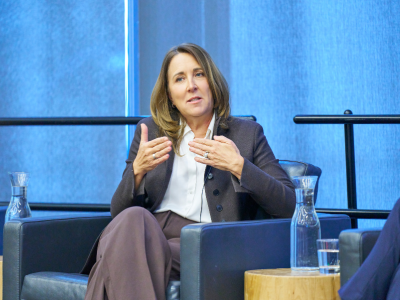
Two years after she first sounded the alarm about declining productivity, Carolyn Rogers, Senior Deputy Governor of the Bank of Canada, shed some light on her memorable call to action at the most recent conference for Canada’s Productivity Initiative.
The one-day session with Rogers in Toronto capped a whirlwind week for the School of Public Policy. It began with the announcement of an unprecedented federal funding agreement for the School to expand the Productivity Initiative to lead a national effort to strengthen economic productivity.
Rogers explained during the session cohosted by the School and the Rotman School of Management at the University of Toronto that the Bank of Canada knew productivity was a major issue but getting Canadians to rally around a difficult-to-define economic term was a challenge.
She said her team that worked on her speeches decided two years ago that “maybe the problem is we’re not talking about it in a way that people can understand or we are not relating it to things that they care about.”
In March 2024, Rogers gave a speech in Halifax titled Time to break the glass: Fixing Canada’s productivity problem. Her relatable call to action of what to do in case of an emergency helped push productivity up the policy agenda.
“I was still only a central banker for two years at that point and I can appreciate I was being a bit more colorful than a central banker normally would be,” Rogers told the more than 300 people in attendance and almost 800 online. “I can tell you I, and everyone at the Bank, was a bit shocked how that phrase seem to capture people, but we’re glad it did. And since then, my colleagues have given more speeches on productivity. It remains important to us.”
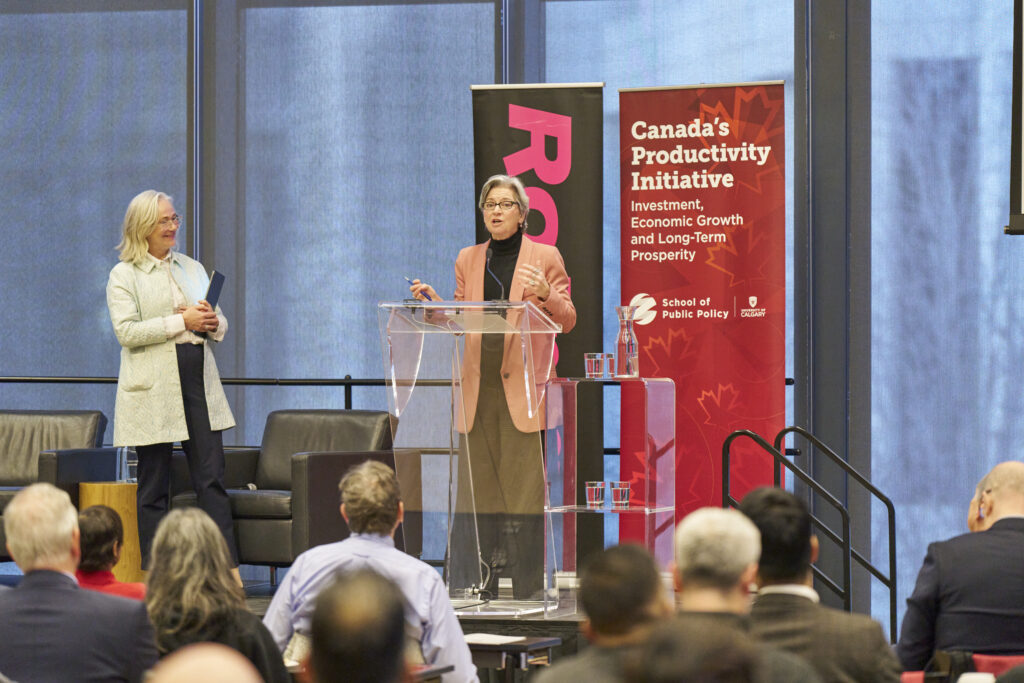
Martha Hall Findlay, Director, School of Public Policy addressing audience in Toronto
Taking up the call to action to address productivity
Two people who took up Rogers’ call to action were Martha Hall Findlay, Director of the School of Public Policy, and Trevor Tombe, Director of Economic and Fiscal Policy at the School.
In October 2024, the School teamed with the Government of Alberta to host Canada’s Productivity Summit in Calgary. The two-day conference attracted delegates from across the country to examine Canada’s productivity issues and find ways to encourage innovation, investment and policy reform.
A What We Heard report from the Summit said: “No one single factor is responsible for the decline in productivity. Rather, the causes include weak capital investment, low levels of business innovation and policies that hinder interprovincial and international trade, along with red tape, overlap, inefficiencies and uncertainties in Canada’s tax and regulatory systems.”
The next step for Canada’s Productivity Initiative was to address why the solutions to well-known issues hadn’t been implemented, and the School held six issue-specific conferences across the country.

Evan Solomon, Minister of Artificial Intelligence and Digital Innovation speaks at the Toronto Session
U.S. President Donald Trump’s tariff wars added much more urgency for Canada to get its own economic house in order.
Over the last year, productivity sessions were held in Ottawa on tax and competition policy, in Halifax on interprovincial trade, in Vancouver on infrastructure and transportation, in Montreal on job skills and immigration and in Saskatoon on agriculture and natural resources.
The Toronto session, the last in the series, was titled The Productivity Challenge: Adoption and Infrastructure and AI-powered growth. As part of the panel discussions on AI, Evan Solomon, the federal Minister of Artificial Intelligence and Digital Innovation also urged collaboration and outlined Ottawa’s refreshed and soon to be released AI strategy supporting adoption of artificial intelligence throughout the economy.
Rogers made her comments in conversation with Bill Morneau, the former federal Finance Minister and Rotman School Executive-in-Residence. Morneau praised effort to bring more perspectives to the policy making process.
“It’s so important to have sessions like this session and the broader sessions that have been led by the University of Calgary’s School of Public Policy,” Morneau said. “We need to find ways to bring people with different expertise, people from the business sector, people who think about this as part of the day-to-day life as academic researchers and people from government who can identify the ways we can make changes.”
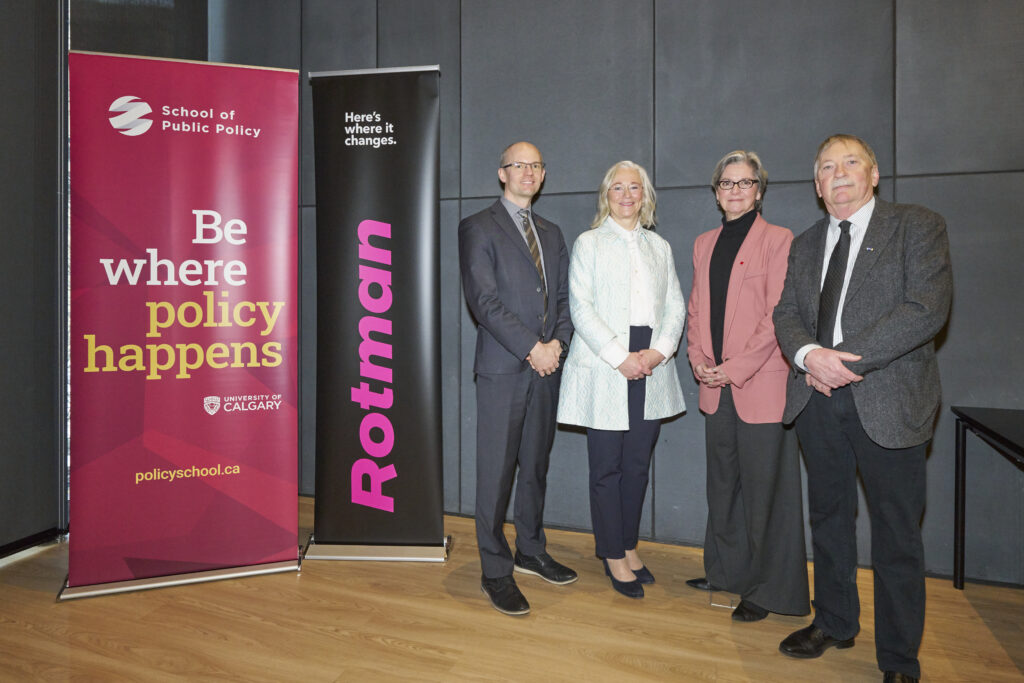
Trevor Tombe, Director, Economic and Fiscal Policy, School of Public Policy; Susan Christoffersen, Dean, Rotman School of Management.; Martha Hall Findlay, Director, School of Public Policy, University of Calgary; Ted Hewitt, President, Social Sciences and Humanities Research Council of Canada (SSHRC)
Partnering to prioritize productivity solutions
On Monday, long-term funding for Canada’s Productivity Initiative’s was put in place with a groundbreaking agreement from Government of Canada through the Social Sciences and Humanities Research Council.
A $6 million federal investment over 15 years will bring together 30 government, academic and research organizations from across the country under the leadership of the School of Public Policy to drive improved productivity.
“What makes the productivity-focused partnership we are here to talk about today so unique is that it combines world class research with policy co-creation and it will build a lasting national capacity so that reforms can be designed and implemented which are essential to our prosperity,” Research Council President Ted Hewitt said at the Toronto event.
The grant is a first from the Research Council under its new pilot Policy Innovation Partnership Grants program. It supports partnerships between postsecondary institutions and the federal government aimed at funding long-term, high-impact research in key areas of importance to Canada’s future.
Hall Findlay said the financial support provides a foundation for on-going collaboration around research and policy discussions. She urged corporate Canada to get more involved help develop solutions to create economic and social prosperity.
“If we think of this as seed support for a massive collective initiative my call out to you as businesspeople, people online who are in the corporate world, come and talk to us,” she said. “The more (people) we have engaging in this — frankly, the more resources we can pull — we can finally actually stop just talking about this, which we have been doing for decades, but in fact we can find real concrete solutions.”