
School of Public Policy brings North American perspective to Indo-Pacific Strategy Forum
In an increasingly unpredictable geopolitical environment, the School of Public Policy is bringing a new perspective to high-level policy discussions on international trade in Canada.
The elevation of the policy discussions around Canada’s role in global trade championed by Carlo Dade, Director of International Policy for the School, was evident at the Indo-Pacific Strategy Forum last month in Ottawa.
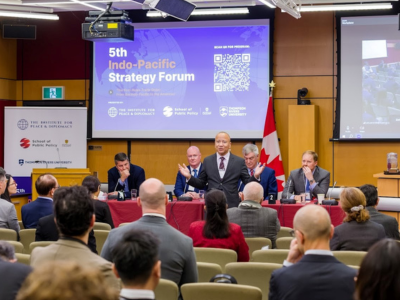
The Forum titled Renewing Indo-Pacific Strategy in a Deglobalizing World Economy took place at the Senate of Canada Building and focused on Canada’s engagement in the region extending from Asia to Latin America.
The conference was organized by the Ottawa-based Institute for Peace and Diplomacy and co-hosted by the School, Thompson Rivers University and University of British Columbia. The conference drew more than 100 representatives from government and business professionals from several countries.
“Most policy conferences in Canada are focused on Canada, and they have limited attention on the geopolitical context in Asia and even less on the United States and Latin America,” said Dade, who is also Director of the New North America Initiative at the School. “Taking a bigger picture view sets the work we are doing international trade apart.”
The School initiated, developed and hosted two of the panels at the conference.
The panel America First, Canada, and an Interdependent Indo-Pacific included Frederick Fleitz of the Centre for American Security, America First Policy Institute, Matt Turpin of the Hoover Institution and Steve Yates of the China and National Security Policy and Sean Speer of the Public Policy Forum and The Hub Canada. It focused on how the America First movement is reshaping the United States role in the world and the Indo-Pacific region.
The speakers said there’s been a recalibration of American attitudes and a push back against perceived shortcomings of multilateral institutions such as the World Trade Organization. It seeks to tie trade more closely to security in response to China’s ascension in the WTO and growing China-Russia-North Korea coordination.
A recording of this panel can be found here as well as on The Hub Canada’s Podcast channels.
The panel Convergence and Divergence of Interest: Latin America, Canada and the Indo-Pacific examined how Latin America’s evolving ties with China and the U.S. shape Canada’s Indo-Pacific engagement. It included Tatiana Palermo, Brazil’s former Secretary of International Agribusiness Relations, Eric Miller of the Rideau Potomac Strategy Group, Omar Narrea of the Centre for China and Asia-Pacific Studies, Universidad del Pacifico, Claudia Trevisan of the Brazil-China Business Council, Ken Frankel of the Canadian Council for the Americas and moderated by CBC’s Evan Dyer.
The panelists said the U.S. views Canada as a critical ally in the region – economically, geographically, and strategically – with both the expectation and necessity of deeper bilateral cooperation on energy, agriculture, and global security despite episodic political tensions.
The full recording of this panel can be found here.
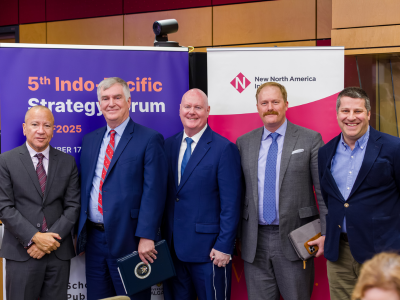
Carlo Dade, Fred Fleitz, Steve Yates, Matt Turpin and Sean Speer
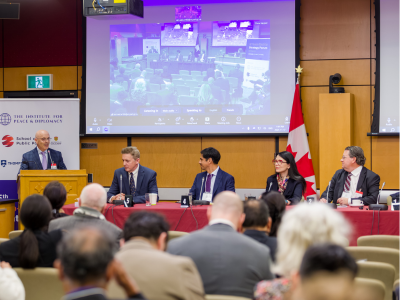
“Latin America, Canada and the Indo-Pacific” panel: Ken Frankel, Evan Dyer, Omar Narrera, Tatiana Palermo and Eric Miller