
SEDV Empowers Students to Tackle Energy Challenges
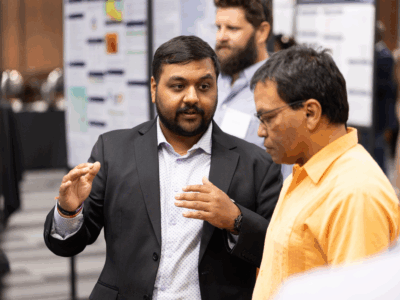
With his background in the energy sector and electricity trading, Chetan Saha joined the Sustainable Energy Development program at the School of Public Policy to deepen his expertise in power system reliability.
Known by its acronym SEDV, the program offers an interdisciplinary approach to tackling real-world energy challenges.
His capstone project, developed in partnership with the Canadian Global Affairs Institute (CGAI), applied machine learning to predict grid stability, which helped to bridge policy, technology, and market insight.
Bridging Policy and Technology
Saha earned his Bachelor of Science in Energy Business and Finance with minors in Energy, Engineering and Geography at Pennsylvania State University before working in electricity trading and forecasting across eastern Canada.
Seeking a master’s program that combined technical and policy dimensions, he explored options across Canada before choosing the Master of Science in the SEDV program, at the University of Calgary.
“I chose the SEDV program knowing that Calgary was a sort of energy hub of Canada,” Saha explained. “But also, because SEDV offered a way to unite private-sector experience with public-policy understanding.”
For his capstone, Saha partnered with the CGAI to build a statistical risk assessment and prediction tool for electricity grid reliability. His research examined three jurisdictions; Alberta (AESO), California (CAISO), and Texas (ERCOT), drawing on published market data to identify early indicators of reliability risks.
Through his analysis, Saha determined that price spikes often precede grid instability, renewable growth increases the need for battery storage, and stronger interties between electricity providers improve system stability. To prove his point, the model he developed was also able to accurately predict a number of 2025 “grid events”, such as power disruptions or outages, using data from 2019–2024.
“It was really eye-opening to see how something like a price spike could line up with these reliability events,” he said. “Once the model started predicting them on its own, it kind of showed how data can help make the grid more reliable.”
Turning Research into Real-World Impact
While the project’s technical demands were high, Saha cites two main challenges; time management and research independence.
“Balancing classes, work, and life was difficult,” he said. “The independence the SEDV capstone gives you is challenging, but it’s also what makes it rewarding, you’re solving real problems with real data.”
These challenges, he added, became valuable lessons in discipline and collaboration. Regular communication with academic and industry supervisors helped him refine his approach and stay on track.
Saha continues to utilize his capstone project for future career prospects. He is working with CGAI on a policy paper on his project experience to discuss regulatory and cost implications in interviews across the power sector. The project also reinforced his goal of connecting data science with sustainable policy design.
Reflecting on his time in the SEDV program, Saha says it provided a bridge between technical knowledge and policy insight, while offering unmatched access to Calgary’s energy industry network.
“I attended different events and conferences hosted by the School of Public Policy,” he explained. “Within my own cohort and attending these events, the School offers students a variety of chances to network and build career prospects.”
For future SEDV students, Saha’s advice is simple: pursue projects that align with your passions and long-term goals.
“The SEDV capstone is your chance to create meaningful, career-aligned research,” he said. “Focus on what genuinely interests you. That can make all the difference.”