MPP Capstone Bridges Theory and Practice
Providing municipal services in rural and remote municipalities is a costly undertaking for local governments, and it is especially challenging when some people using those services aren’t helping to pay for them.
For his Capstone project to earn his Master of Public Policy, William Dunstan wanted to understand how much greater that challenge is for municipalities in Northern Ontario dealing with increasingly large populations who live beyond municipal boundaries but use municipal services.
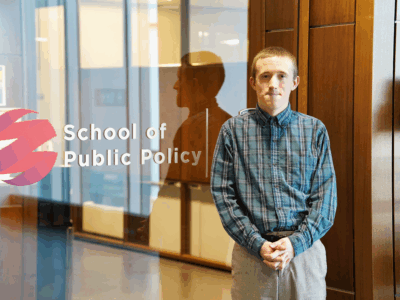
Dunstan (MPP, ’25) focused his Capstone project on how fringe populations in Northern Ontario’s unorganized areas impact the cost of municipal services.
Dunstan grew up in Ontario and completed his undergraduate studies in Public Affairs and Policy Management at Carleton University in Ottawa. He spent a few years working at the Northern Policy Institute; a think tank focused on the growth of sustainable communities in Northern Ontario.
When he decided to pursue his Masters, the MPP program at the School of Public Policy at UCalgary was the ideal choice.
“Both during my undergraduate and in my professional experience, I’d regularly encountered publications from people associated with the School of Public Policy,” Dunstan said. “I was impressed by how well the School and faculty contributed to real-world policy debates and went beyond just academic theory.”
The Capstone project allowed him to revisit a policy issue he had an interest in related to the work he’d done in Ontario.
“This question of fringe populations in Northern Ontario and the potential financial impact they have on municipalities kept coming up,” Dunstan emphasized.
Local governments in Northern Ontario operate differently than those in Alberta. In Northern Ontario, some regions have no municipal authority below the provincial government, creating unique challenges for funding and delivering services to residents in these unorganized areas.
There is debate in Northern Ontario about how much residents of unorganized areas who live close to towns and cities place demands on services provided by these municipalities. The concern is that these “fringe populations” benefit from municipal services – from roads and policing to parks and recreation programs – without paying property taxes to the municipalities.
Dunstan set out to find out the extent of this problem.
Working with faculty advisor Dr. Trevor Tombe, Dunstan said the experience reinforced what he valued about the program.
“The Capstone is a great opportunity to explore a topic you’re interested in while receiving guidance on your research from leading experts at the School. Dr. Tombe’s input helped me turn a broad idea into a strong research project,” Dunstan said.
By using regression analysis, he identified there was a relationship between the relative size of their fringe populations and how much they’re spending per capita.
“Municipalities with larger fringe populations tend to spend a bit more. This is what appears in the data, even after controlling for various other factors that might influence spending.” Dunstan said, adding there needs to be a greater alignment between who uses services, who pays for them, and who is involved in decision-making about these services.
Serving as the cornerstone of the MPP curriculum at the School, the Capstone project challenges students to integrate theory and practice by addressing complex policy problems through rigorous, evidence-based analysis
Dunstan’ said his Capstone reinforced how rigorous policy research can translate into meaningful, actionable solutions for communities.
“My research doesn’t just contribute to academic literature, it adds to our understanding of an issue that governments are actively dealing with,” said Dunstan, who is now a policy researcher at The Fraser Institute and intends to continue working on fiscal and rural policy issues.
Dunstan believes the MPP Capstone project is a great way to take these findings and get them to an audience that would be interested in doing something about it.
Learn more about the one-year integrated MPP program and the Capstone Project overview.